Free · web beta · Ephesians
The Bible Study App
A free Bible study app that shows a passage through denominational, historical, and scholarly lenses—with sources you can check. Currently in beta with the book of Ephesians, published under the working title Through Every Lens.
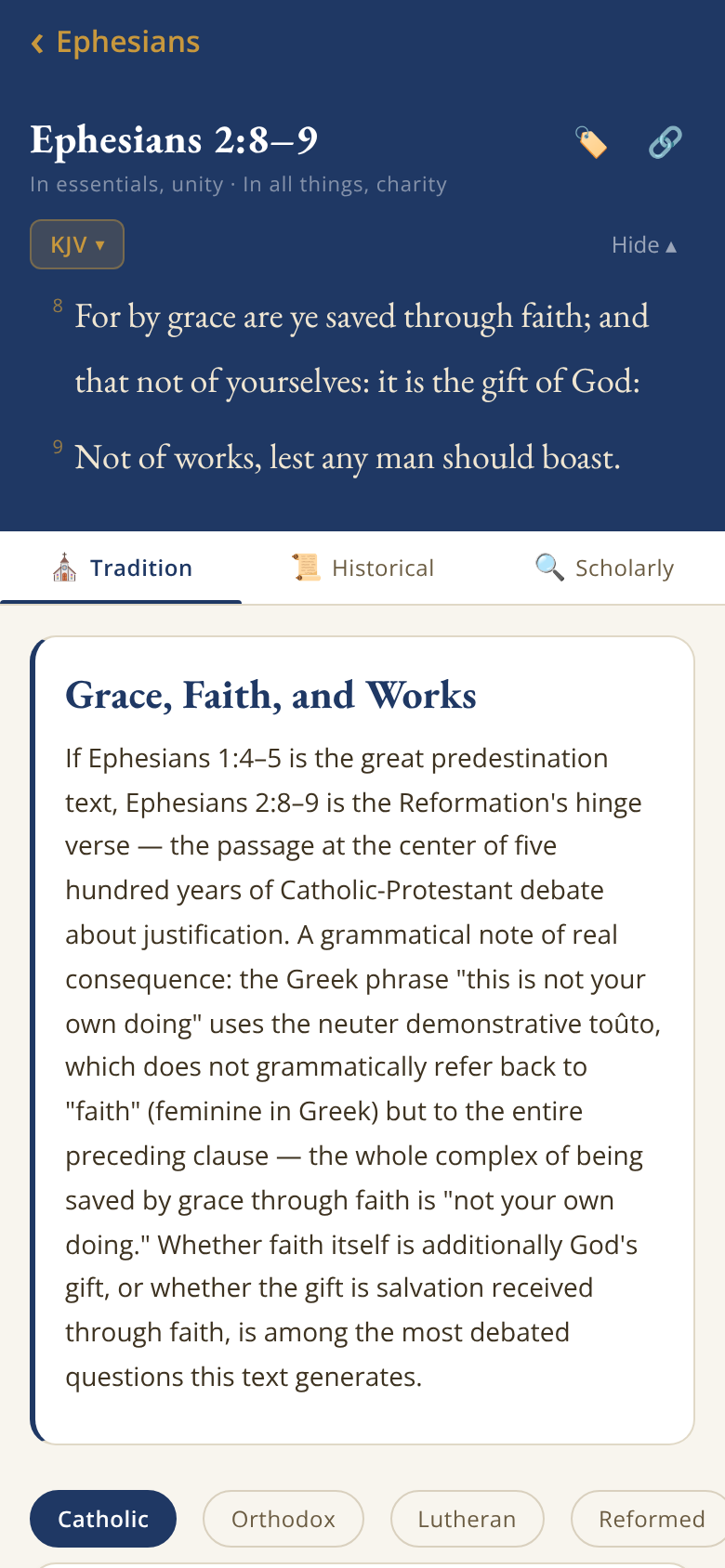
Made for curious small-group leaders
Leaders often have limited time and limited access to perspectives outside their own tradition. Unexamined assumptions can quietly narrow a discussion. The app is designed to bring new depth to your next conversation: see how different Christian traditions understand a passage, consider its historical context, and help your group discuss both shared beliefs and meaningful differences.
Understanding a view does not require agreeing with it. The app's guiding saying, often attributed to Rupertus Meldenius, appears at the top of every passage: “In essentials, unity; in non-essentials, liberty; in all things, charity.”
Three lenses on every passage
Open any passage in Ephesians and the text appears first, in the King James Version. Beneath it, three tabs.
-
Tradition
How eight Christian traditions read the passage, in terms their own adherents would recognize, followed by a plain summary of where the traditions agree and where they differ.
- Catholic
- Orthodox
- Lutheran
- Reformed
- Methodist
- Baptist
- Anglican
- Pentecostal
-
Historical
How the passage was received and used across time: the early church, the patristic era, the Reformation, and the modern period—including manuscript evidence and the Greek vocabulary behind key phrases.
-
Scholarly
Where current critical scholarship broadly agrees on the passage, where it is divided, and what is at stake in the difference—with a numbered list of sources and further reading on every passage.
What the app looks like on a larger screen

What's in the beta today
| Books | Ephesians, chapters 1–6, divided into 36 passages |
|---|---|
| Translation | King James Version (public domain). Additional translations depend on licensing. |
| Lenses | Tradition, Historical, Scholarly |
| Traditions | Eight, with “where they agree” and “where they differ” summaries |
| Sources | A numbered sources-and-further-reading list on every passage |
| Platform | Web app that runs in any modern browser; installable on phones |
| Cost | Free, with no advertising and no account required |
How the research is done, and its limits
AI supports the current research. Every passage lists the sources its summaries draw on so that readers can examine them directly. What the beta does not yet have is independent scholarly review. Establishing that review—a doctoral-level academic partner and a documented workflow that checks that sources exist, that citations support the claims made, and that each tradition is represented fairly—is our next funding priority.
Until then, treat the app as a thoughtful starting point for discussion rather than a settled authority. If you find an error, a misattributed source, or a tradition described in a way its adherents would not recognize, tell us. Corrections are reviewed and the passage is updated.
What comes after Ephesians
These are goals for the next stage, in the order we intend to pursue them. Timelines depend on funding and review quality, not the calendar.
Review leadership
Recruit a scholarly partner, agree source and correction standards, and test the review workflow on Ephesians.
Reviewed content, in increments
Release reviewed material in manageable pieces while improving usability from leader feedback.
Wider coverage
Extend research through the New Testament and release free native apps as resources allow.